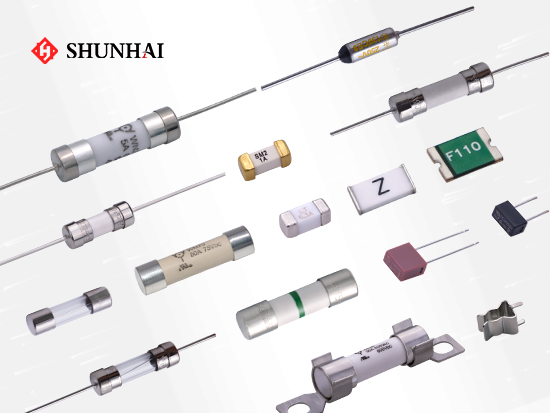
Temperature fuse, also known as thermal fuse link (national standard GB9816.1-2013), is a temperature sensing circuit cutting device. Temperature fuse can induce abnormal overheating of electrical and electronic products, thus cutting off the circuit and avoiding fire. Commonly used in hair dryers, electric irons, rice cookers, electric furnaces, transformers, motors, water dispensers, coffee pots, etc. It should be noted that the temperature fuse can no longer be used after operation, and can only be operated once at the fusing temperature. Then the working principle and operating temperature test method of temperature fuse are sorted out by Shunhai Science and Technology Xiaobian below, and the specific related contents are referred to.
I. Working principle of temperature fuse
The equipment temperature rises abnormally, and the temperature fuse (thermal fuse) senses the ambient temperature. When the temperature reaches the melting point of the easy-to-melt gold, the easy-to-melt gold melts. Under the action of special resin, the molten alloy shrinks rapidly into balls and cuts off the current.
II. Explanation of temperature test method for temperature fuse operation is as follows
1. List of test equipment
(1) THERMOMETER thermometer.
(2) SILICON OIL BATH in silicone oil pool
(3) STIRRER mixer
(4) SAMPLE
(5) FIXTURE
(6) Light emitting diode LED
(7) current limiting RESISTOR resistor
(8) HEATER heater
2. Test flow of temperature fuse
(1) connect the two pins of the sample to the fixture of the test equipment, turn on the test current of about 10mA (the maximum is not more than 100mA), and indicate the disconnection of the test current with the light-emitting diode;
(2) The temperature of the silicone oil pool should be stabilized at TF-10℃ (the silicone oil pool should be equipped with a stirrer to ensure uniform temperature and controllable heating speed), and then the sample should be put into the silicone oil pool, and the thermometer probe should be as close to the sample as possible;
(3) controlling the temperature of the silicone oil pool to rise at a speed of 0.5-1 DEG C per minute, and recording the thermometer reading and the action temperature of the sample when the light emitting diode goes out;
(4) If there is no oil pool testing equipment, it can also be tested in a thermostat with a blower device, but attention must be paid to keeping the thermometer probe close to the sample to obtain accurate results;