When selecting a voltage regulator diode, a comprehensive evaluation should be conducted from four dimensions: electrical parameters, application scenarios, reliability, and supply chain. The following are key considerations and logical selection guidelines:
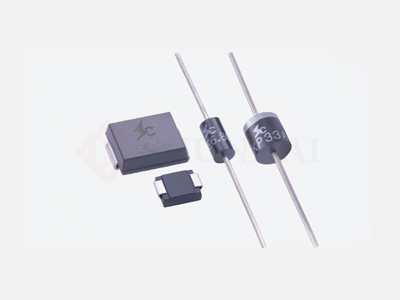
1、 Matching of core electrical parameters
Voltage stabilization value (Vz) accuracy
Selection of nominal values: Priority should be given to selecting the standard values that are closest to the circuit requirements (such as 5.1V, 6.2V) to avoid supply chain risks caused by non-standard values.
Tolerance control: Precision circuits require a precision model of ± 1% to ± 2%, and a tolerance of ± 5% is acceptable in general scenarios.
Temperature drift verification: Check the temperature coefficient (TC) through the data manual to ensure that the voltage fluctuation in the entire temperature range is within the allowable range (such as ± 0.01%/℃).
Power consumption and derating design
Power calculation: The actual power consumption P=Vz × Iz, which needs to be ≤ 50%~70% of the rated power consumption (Pz).
Package heat dissipation matching: For high-power scenarios (>1W), it is necessary to choose a package with heat dissipation fins (such as SMC, TO-277), or install heat dissipation fins.
Dynamic characteristic evaluation
Dynamic resistance (Rz): The smaller Rz, the higher the voltage stability, and high-frequency circuits require Rz<10 Ω.
Reverse recovery time (trr): The switching power supply should choose a fast recovery model with trr<100ns (such as US1M).
2、 Application scenario adaptation
Consumer electronics scene
Key requirements: low cost, miniaturization, and low power consumption.
Selection suggestion: Prioritize SOD-123/SOT-23 packaging and pay attention to reverse leakage current (Ir<1 μ A).
Typical models: BZX84C5V6 (SOT-23), LL4148 (SOD-80).
Industrial control scenario
Key requirements: high reliability, wide temperature range, and vibration resistance.
Selection suggestion: Choose DO-15/DO-201 plug-in packaging to verify AEC-Q101 certification (such as automotive grade applications).
Typical models: 1N5333B (DO-15), SMCJ53A (SMC).
Automotive electronic scene
Key requirements: Vehicle grade certification, high ESD tolerance, wide voltage range.
Selection suggestion: Choose an AEC-Q101 certified model (such as BZX84C5V6LT1G) and pay attention to its transient voltage suppression capability.
Typical model: P6KE200A (TVS+Zener diode two in one).
3、 Packaging and Reliability Design
Packaging thermal performance evaluation
Thermal resistance calculation: θ JA=(Tj Ta)/P, ensuring that the junction temperature Tj<150 ℃ (for silicon-based devices).
Recommended solution:
Below 1W: SOD-123 (θ JA ≈ 200 ℃/W)
Below 3W: SMA/SMB (θ JA ≈ 150 ℃/W)
Above 5W: SMC/TO-277 (θ JA<50 ℃/W)
Mechanical stress protection
Plug in packaging: Priority is given to DO-15 (metal glass packaging) instead of DO-41 (plastic packaging), which improves vibration resistance by three times.
Surface mount packaging: Choose models with corner reinforcement (such as SMCJ series) to avoid welding cracks.
Lifespan and Failure Modes
Key verification: Through HTRB (high temperature reverse bias) testing, confirm that the leakage current change after 1000 hours is less than 5%.
Failure prevention: Avoid long-term operation near Izmax, recommended working current ≤ 70% Izmax.
4、 Supply Chain and Cost Optimization
Brand and Original Factory Selection
International brands: onsemi and ROHM are suitable for high-end precision scenes.
Domestic brands: Yangjie Technology and Changjing Technology have outstanding cost-effectiveness and short delivery cycles.
Emerging brand: SLKOR has made technological breakthroughs in the third-generation semiconductor field.
Inventory and Lifecycle Management
Long term materials: Automotive grade certified models need to be stocked 12 weeks in advance.
Alternative material verification: Confirm the feasibility of substitution through parameter comparison tables (Vz, Ir, TC) to avoid functional risks.
Cost sensitive design
Discrete solution: Low power scenarios can use transistors and Zener diodes instead of integrated regulators, reducing costs by 40%.
Batch procurement: When the purchase quantity of a single model exceeds 10K, the bargaining space with the original factory can reach 15% to 20%.
5、 Selection Decision Process
Requirement definition: Clarify core parameters such as Vz, Iz, packaging, and authentication.
Preliminary screening: Use Digi Key/Mouser parameter search tool to screen 5-10 candidate models.
Detailed evaluation: Download the data manual and compare key indicators such as Rz, TC, Ir, etc.
Prototype validation: Produce test boards to verify temperature rise, voltage stabilization accuracy, and long-term reliability.
Supply chain confirmation: Confirm inventory, MOQ, and delivery lead time with distributors.
Through the above systematic evaluation, a selection scheme for voltage regulator diodes that is suitable for different scenarios can be constructed. In practical engineering, it is necessary to balance performance, cost, and delivery risks to avoid excessive design of a single parameter.


