Zener diodes and Zener diodes are usually considered the same device in engineering practice, but there are subtle differences strictly from the perspective of physical mechanisms and terminology specifications. The following is a systematic analysis based on technical principles, industry conventions, and practical applications:
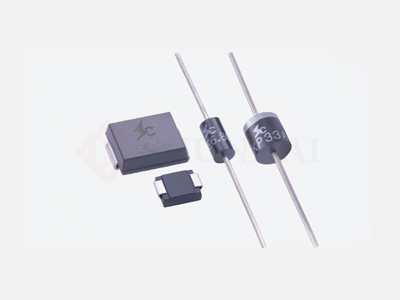
1、 Differences and correlations in physical mechanisms
Zener diode
Core mechanism: Relying on the Zener breakdown effect, where the electric field directly causes valence band electrons to enter the conduction band through quantum tunneling effect, achieving reverse conduction.
Applicable scenarios: Low voltage stabilization (usually<5.6V), as Zener breakdown is more likely to occur at low voltages.
Typical applications: Precision reference source (such as LM385), voltage clamp for low-power circuits.
Avalanche diode
Core mechanism: Dependent on avalanche breakdown effect, where charge carriers collide and ionize under a strong electric field, resulting in a chain reaction and the formation of reverse current.
Applicable scenarios: High voltage stabilization (>5.6V), avalanche breakdown is dominant under high voltage.
Typical applications: overvoltage protection for power modules, surge absorption for industrial equipment.
Engineering equivalence
Reason for term mixing: In the vast majority of application scenarios, both are collectively referred to as "voltage stabilizing diodes" because their core function is to achieve voltage stability through reverse breakdown, and the circuit design method is completely consistent (requiring series current limiting resistors and reverse bias).
Data manual verification: For example, ROHM's 1SMA series voltage regulator diode is labeled with both "Zener Diode" and "Voltage Regulator Diode" in the parameter table, further confirming the equivalence of terminology.
2、 Standardization and conventions of industry terminology
International Standards (JEDEC)
In the JEDEC standard, "Zener diode" and "Voltage regulator diode" are synonymous, both referring to diodes with voltage stabilization function, without strictly distinguishing the breakdown mechanism.
Exception scenario: In semiconductor physics textbooks or high-precision device data manuals, it may be explicitly labeled as "Zener" or "Avalanche" to distinguish the mechanism.
Manufacturer naming conventions
Onsemi: The N47xx series voltage regulator diode is labeled as "Zener diodes", but the technical documentation clearly states that it includes two types of breakdown: Zener and Avalanche.
Yangjie Technology: The M7 series high-voltage regulator is labeled as "Voltage Regulator Diode", which is actually based on avalanche breakdown mechanism.
3、 The uniformity of engineering selection
Consistency of core parameters
Regardless of whether the mechanism is Zener or avalanche, the selection should pay attention to the following parameters:
Voltage stabilization value (Vz): It needs to match the circuit requirements (such as 5.1V, 12V).
Power consumption (Pz): A margin of at least 50% is required (such as selecting the 1.5W model for a 1W application).
Packaging thermal resistance: For high-power scenarios, low thermal resistance packaging such as SMC/TO-277 should be selected.
Equivalence of design methods
Typical circuit: The voltage regulator diode needs to be reverse biased and connected in series with a current limiting resistor. The calculation formula is:
R=Iz+IloadVin−Vz
Application case: When a 6.2V voltage regulator diode is connected in parallel in a 5V power supply, engineers do not need to distinguish its breakdown mechanism, only need to verify the voltage regulator value and power consumption parameters.
4、 Balance between academic rigor and engineering practice
Academic scenario: In semiconductor device physics research or high-precision device design, it is necessary to strictly distinguish between Zener and avalanche mechanisms, for example:
Zener diodes have a lower temperature coefficient (due to their insensitivity to temperature caused by tunneling effects) and are suitable for precision reference sources.
Avalanche diodes have better noise performance and are suitable for RF signal conditioning.
Engineering scenario: In 99% of circuit designs, the two are considered as the same device, and the selection criteria are only based on functional requirements and parameter matching, rather than physical mechanisms.
5、 Conclusion
Zener diodes and Zener diodes can be considered as the same device in engineering practice, and their terminology is mixed due to functional equivalence and industry conventions. However, it is important to distinguish between the following scenarios:
Academic research: It is necessary to clarify the breakdown mechanism in order to analyze device characteristics.
High precision design: Zener diodes are more suitable for reference sources due to their low temperature coefficient.
Special application: Avalanche diodes are more suitable for RF circuits due to their low noise characteristics.
For the vast majority of engineers, mastering the selection principles of "voltage regulator diodes" (such as voltage matching, power consumption derating, and packaging thermal design) can cover 99% of application scenarios, and differences in terminology do not affect actual circuit design.


