As a key component in electronic circuits, the core value of switch diodes lies in achieving high-speed and high-frequency current on/off control. The following systematically analyzes the characteristics of switch diodes from five dimensions: basic features, performance advantages, technical classification, application scenarios, and selection logic.
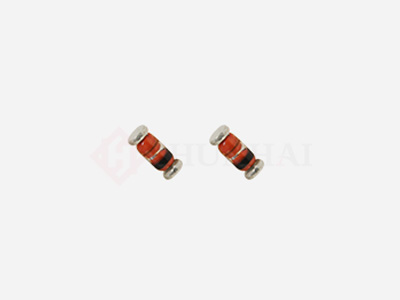
1、 Basic characteristics: High frequency response and low parasitic parameters
Switching Speed
Reverse recovery time (trr): measures the switching speed of a diode from conduction to cutoff. The shorter the trr, the lower the switching loss. For example, the trr of a ultrafast recovery diode (UFRD) can be less than 50ns, while the trr of a regular rectifier diode can reach hundreds of nanoseconds.
Junction capacitance (Cj): The junction capacitance of a switching diode is usually less than 10pF, such as the BAS70 series, to ensure the integrity of high-frequency signal transmission.
volt-ampere characteristic
Forward conduction: When the forward voltage exceeds the threshold (about 0.7V for silicon diodes and about 0.2V for Schottky diodes), the current increases exponentially.
Reverse cutoff: Under reverse bias, the leakage current is extremely small (usually microampere level), forming a high resistance state.
2、 Performance advantages: high frequency efficiency and low loss
high-frequency characteristics
Applicable frequency: Switching diodes can operate in the MHz or even GHz frequency band, while Schottky diodes (such as 1N5819) can maintain stable performance at 100MHz.
Switching loss: Low trr and Cj reduce the energy loss of switching diodes during high-frequency switching. For example, in switching power supplies, the efficiency of UFRD is increased by more than 10% compared to ordinary diodes.
Temperature Stability
Operating temperature range: Silicon based switch diodes can operate within the range of -55 ℃ to 150 ℃, while silicon carbide (SiC) diodes (such as C3D04060A) can operate at a temperature of up to 225 ℃.
Thermal resistance optimization: Through packaging forms such as TO-220, the thermal resistance can be as low as 0.5 ℃/W, ensuring long-term reliability.
3、 Technical Classification: Diversity of Materials and Structures
Silicon-based diode
Fast Recovery Diode (FRD): such as FR107, trr=50-200ns, suitable for switching power supplies and inverters.
Ultra fast recovery diode (UFRD): such as UF4007, trr<50ns, used for high-frequency communication equipment and precision power supplies.
Schottky diode
Features: Extremely low forward voltage drop (VF ≈ 0.2V), fast switching, but low reverse withstand voltage (usually ≤ 200V).
Application: Low Dropout Linear Regulator (LDO), High Frequency DC-DC Converter.
Wide bandgap semiconductor diode
Silicon carbide (SiC) diodes, such as CREE's C3D series, have high voltage resistance levels (600V-1700V) and trr<20ns, making them suitable for new energy vehicle electronic control systems and photovoltaic inverters.
Gallium Nitride (GaN) diodes, such as EPC2039 from EPC, reduce switching losses by 60% compared to silicon-based devices, promoting the miniaturization of 5G power modules.
4、 Application scenarios: covering the entire field of high-frequency electronics
communication devices
RF detection: In AM/FM broadcast receivers, Schottky diodes (such as 1N5711) demodulate high-frequency carrier signals into audio signals.
Pulse shaping: In digital circuits, UFRD shapes clock signals to eliminate noise interference.
Power management
Switching power supply: In PFC (Power Factor Correction) circuits, FRD works in conjunction with inductors and capacitors to achieve efficient energy conversion, with an efficiency of over 95%.
DC-DC converter: Schottky diodes reduce voltage drop losses and improve conversion efficiency in buck circuits.
Automotive Electronics
Electric vehicle OBC: using SiC diodes to achieve efficient rectification under 800V high voltage platform, increasing charging efficiency by 15%.
Motor controller: UFRD suppresses voltage spikes in the inverter bridge arm to protect power devices.
Industrial control
Stepper motor drive: During phase current switching, the diode provides a freewheeling circuit to suppress voltage spikes and protect the drive chip.
Surge suppression: Connect TVS diodes in parallel at the power input end to absorb transient high voltage generated by lightning strikes or power on/off.
5、 Selection logic: parameter matching and scene adaptation
Frequency requirements
High frequency scenarios (>1MHz): Preferably choose Schottky diodes or UFRDs, such as 1N5819 (100MHz) or UF4007 (50MHz).
Low frequency scenarios (<100kHz): FRD (such as FR107) can meet the requirements.
Voltage and Current
Voltage endurance redundancy design: Reverse voltage endurance (VR) needs to be 20% -30% higher than the peak voltage of the circuit. For example, VR ≥ 600V is required for 220V AC applications.
Current margin: The forward average current (IF) should be 1.2-1.5 times greater than the actual operating current. High power scenarios require the selection of IF ≥ 100A models.
Packaging and heat dissipation
Miniaturization requirements: 0402 packaging (such as ROHM's RLB series) is suitable for wearable devices, with a volume of only 0.4mm × 0.2mm.
High power scenario: TO-220 package with heat sink, or direct use of SiC module (such as Infineon's HybridPACK) ™ Drive), The power density reaches 50kW/L.
Special scenario adaptation
High temperature environment: Choose SiC diodes (such as C3D04060A) with a working temperature of 225 ℃.
Radiation environment: Choose radiation resistant reinforcement models (such as Microsemi's APT series), suitable for aerospace electronics.
summarize
Switching diodes have the core advantages of high frequency response and low loss, covering a wide range of scenarios from communication to industry, from consumer electronics to new energy vehicles through material innovation (such as SiC, GaN) and packaging optimization (such as DFN, QFN). When selecting, it is necessary to combine frequency, voltage, current, and heat dissipation requirements to match the technical indicators of specific application scenarios. With the popularization of third-generation semiconductor technology, switch diodes continue to evolve in the direction of "high frequency, high efficiency, and high temperature".


